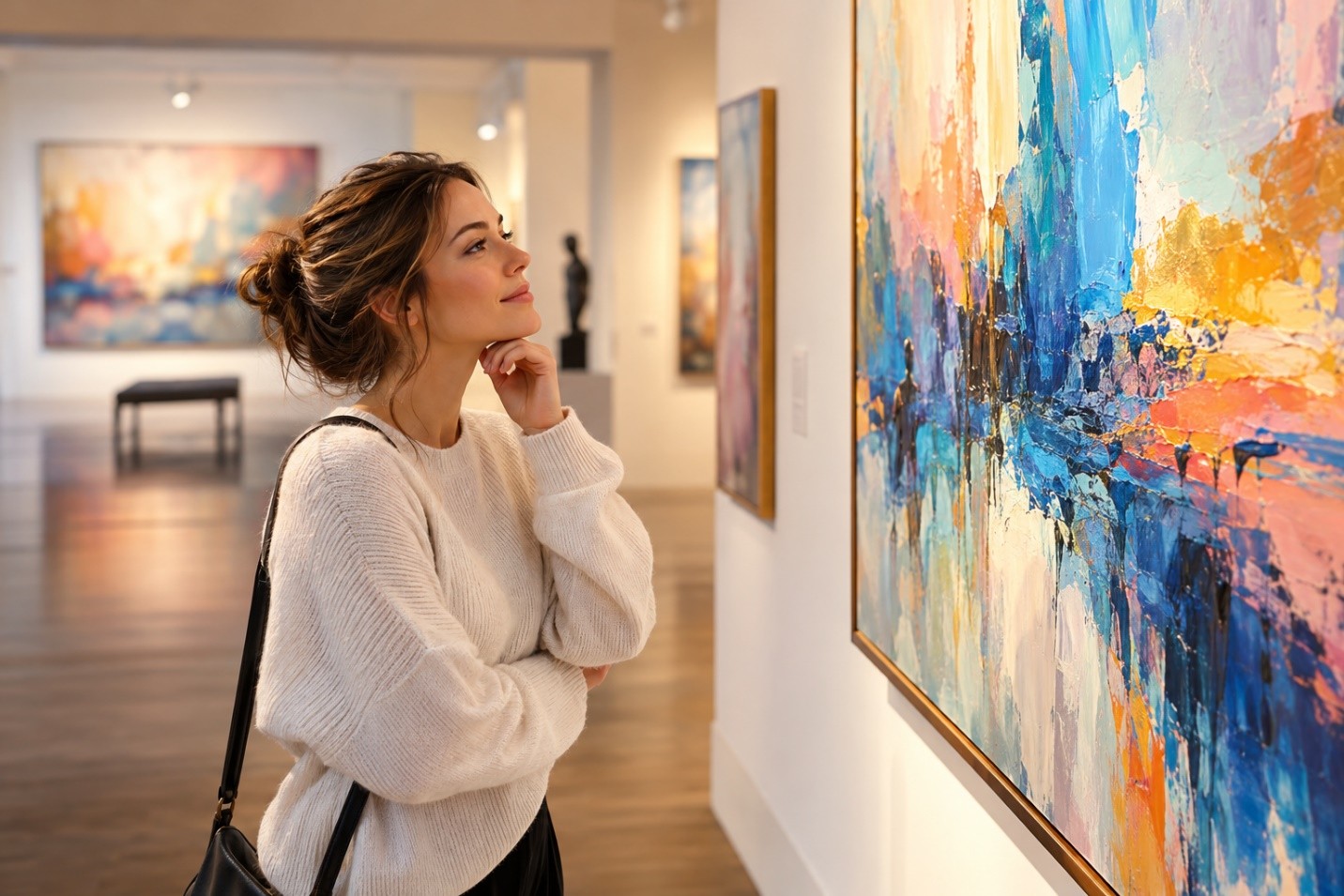
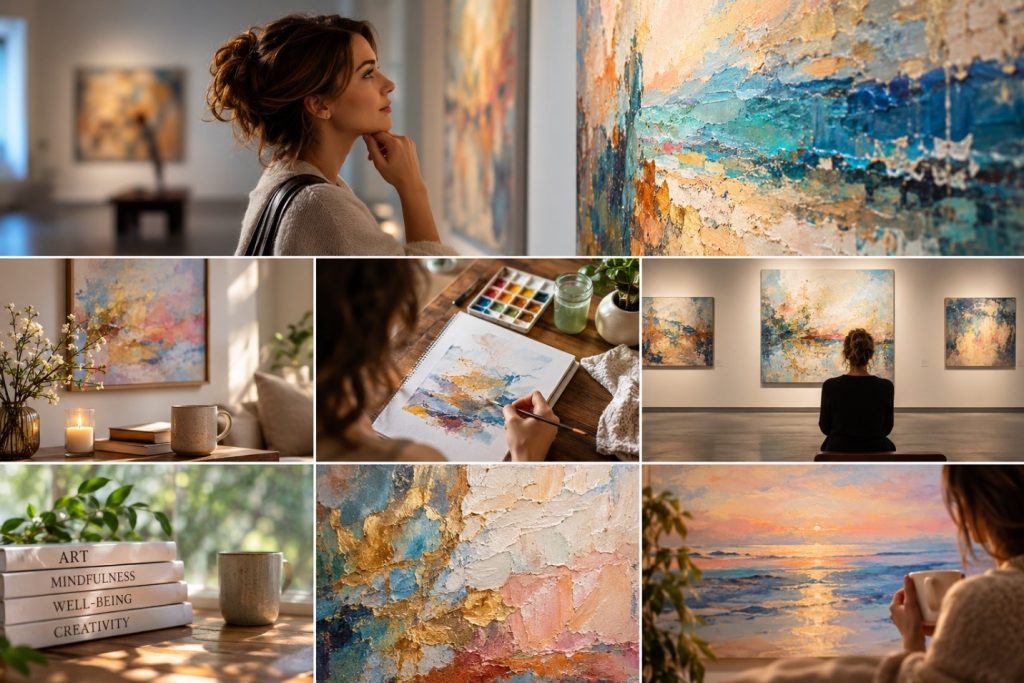
Stress is a common part of modern life, and people are constantly looking for simple ways to relax and improve their mental well-being. While exercise, meditation, and spending time in nature are widely discussed stress-management strategies, one activity that deserves more attention is looking at art.
Can looking at art reduce stress? Research suggests that it may help reduce perceived stress and support psychological well-being, although the effects vary between individuals and studies. From paintings and sculptures to landscape artwork and museum exhibitions, visual art may offer an opportunity to slow down, shift attention away from daily worries, and experience positive emotions.
But what does science actually say? Can looking at paintings lower cortisol, improve mood, or reduce anxiety? And does the type of artwork matter?
In this article, we explore the scientific research on art viewing and stress reduction, explain the possible psychological mechanisms, and share practical ways to incorporate art into everyday life.
Research into art viewing and mental health has grown over the past several years. Scientists have investigated whether viewing visual artworks can influence emotional responses, perceived stress, and certain physiological indicators associated with stress.
The review examined 14 studies investigating the relationship between viewing visual art and stress-related outcomes. Thirteen studies reported reductions in self-reported stress, suggesting that viewing art may have a positive effect on how people experience stress.
However, these findings should be interpreted carefully. The studies differed in their methods, participants, settings, and measurements. A reduction in self-reported stress does not automatically demonstrate a corresponding reduction in physiological stress markers.
More recent research has continued to explore the relationship between art viewing and well-being. A 2025 systematic review examined the broader effects of viewing art on psychological well-being, while research published in 2026 investigated subjective and physiological responses to art exhibitions.
Together, these studies suggest that looking at art may support well-being, but the strength and consistency of the effects depend on the outcome being measured and the circumstances in which the artwork is viewed.
There is no single explanation for why looking at art might help people feel less stressed. Several psychological processes may contribute to the experience.
Stress often involves repetitive thoughts about responsibilities, deadlines, relationships, and uncertainty. Looking closely at an artwork can provide a different focus for attention.
Instead of concentrating on stressful thoughts, a person may begin noticing colors, shapes, textures, lighting, and small visual details.
This temporary shift in attention may offer a mental break from everyday concerns. The experience will not necessarily resolve the source of stress, but it may help someone feel more present in the moment.
For example, spending a few minutes observing a landscape painting may encourage someone to notice the arrangement of trees, the movement of clouds, or the contrast between light and shadow.
This kind of focused observation can become a simple opportunity to pause during a busy day.
Visual art can evoke a wide range of emotions, including calmness, curiosity, happiness, nostalgia, and wonder.
The emotional response depends on the artwork and the viewer. A peaceful landscape may feel comforting to one person, while a vibrant abstract painting may create a similar feeling for someone else.
Positive emotional experiences may help counterbalance unpleasant feelings associated with stress. However, not every artwork produces a positive response, and some pieces may evoke sadness, discomfort, or intense emotions.
This is why personal preference can be an important consideration when choosing artwork for relaxation.
Mindfulness involves paying attention to the present moment without immediately judging or reacting to every thought.
Looking at art can provide a simple way to practice this kind of attention. Rather than trying to analyze a painting or understand its meaning, a viewer can focus on what they actually see.
They might notice the colors, follow the lines, observe the composition, or consider how different parts of the artwork relate to one another.
Although looking at art is not automatically the same as mindfulness meditation, it can create an opportunity for slower, more deliberate attention.
The experience of viewing art can involve more than relaxation. It may also encourage reflection, curiosity, emotional engagement, and a sense of connection with other people or cultures.
A museum visit, for example, can combine visual experiences with movement, learning, social interaction, and a change of environment.
These factors make it important to distinguish the effect of the artwork itself from the broader experience of visiting an exhibition or gallery.
Researchers are continuing to investigate how these different elements contribute to well-being.
Cortisol is a hormone involved in the body’s stress response. It helps regulate several processes, including metabolism and the body’s response to challenges.
Because cortisol can change in response to stressful situations, researchers sometimes measure it when investigating potential stress-reduction activities.
However, feeling less stressed and showing a measurable reduction in cortisol are not the same thing.
A person might report feeling calmer after viewing a painting even when a biological measurement does not show a corresponding change. Similarly, cortisol levels can vary depending on the time of day, recent activity, sleep, and other factors.
Research on art viewing has reported encouraging findings for some stress-related outcomes, but the evidence is not consistent enough to conclude that looking at art reliably lowers cortisol in every setting.
If someone feels more relaxed after looking at a painting, that experience can still be meaningful even if their cortisol levels have not been shown to decrease.
The relationship between art and stress may depend partly on the artwork itself and how a person responds to it.
There is no universally established art style that is best for everyone. Nevertheless, different types of artwork offer different visual and emotional experiences.
Landscape paintings often depict forests, mountains, oceans, gardens, rivers, or open skies.
For some viewers, these images may evoke associations with nature, peaceful environments, or pleasant memories. They can also provide a visual focus that feels less demanding than a busy or highly detailed composition.
Nature imagery is worth exploring if you find outdoor environments relaxing. However, evidence about viewing nature itself should not automatically be treated as proof that nature paintings produce the same effects.
Abstract artwork uses color, form, line, and composition without necessarily representing recognizable objects.
Some people find abstract art engaging because it allows them to explore visual patterns without searching for a specific meaning. Others may prefer artwork with recognizable subjects.
Abstract art can therefore be a useful personal choice, but there is not enough evidence to claim that it is universally more effective than other art styles for stress reduction.
Figurative art represents people, objects, or recognizable scenes.
Portraits and narrative paintings may encourage viewers to think about human emotions, relationships, and personal experiences. Depending on the artwork, this can be comforting, thought-provoking, or emotionally challenging.
Such research helps explore the relationship between art appreciation and well-being, although findings from a particular museum setting should not automatically be generalized to every artwork or viewer.
Another interesting question is whether viewing an original painting in a museum has a different effect from looking at the same image on a phone or computer.
Museum visits offer several experiences beyond the artwork itself, including the physical environment, distance from everyday responsibilities, and opportunities for reflection.
Digital images, on the other hand, make visual art accessible at home, at work, or during a short break.
These experiences are not necessarily equivalent. More direct research is needed before concluding that original artwork is always more relaxing than digital art, or vice versa.
The most useful starting point is to choose artwork that you personally enjoy and observe how you respond to it.
There is no universally established duration of art viewing that guarantees stress reduction.
You do not necessarily need to visit a museum or spend a long time studying a painting to explore whether looking at art helps you feel calmer.
Instead, you can try a short, self-guided activity and pay attention to your own experience.
Select a painting, photograph, sculpture, or digital artwork that interests you. You might choose a landscape, an abstract composition, or a piece that reminds you of a positive experience.
For a few minutes, silence unnecessary notifications and focus on the artwork. There is no need to force yourself to relax or feel a particular emotion.
Notice the colors, shapes, lines, textures, and arrangement of objects. Allow your attention to move naturally across the artwork.
Ask yourself whether you feel interested, calm, curious, reflective, or unchanged. There is no correct response.
If useful, rate your perceived stress on a simple scale from 0 to 10 before and after the exercise. Repeat the activity on different days if you want to see whether you notice a pattern.
This exercise is a practical way to explore your personal response. It is not a validated medical treatment, and a change in your self-rating does not prove that your physiological stress has decreased.
If the artwork makes you uncomfortable, choose something else. The goal is to explore what works for you rather than force a particular experience.
Looking at art and participating in art therapy are related but distinct activities.
Art viewing involves observing and experiencing existing artwork. It can take place in a museum, at home, in a workplace, or through a digital image.
Creating artwork independently can also be enjoyable or emotionally meaningful, but it is not automatically equivalent to professional art therapy.
Research on art-making, art therapy, and passive art viewing should therefore be considered separately. Findings from one activity cannot automatically establish the benefits of another.
For someone looking for a simple way to take a break, viewing art may be an accessible option. For people experiencing persistent anxiety, overwhelming stress, or other mental health concerns, professional support may be more appropriate.
Although the findings are promising, there are several reasons to avoid making exaggerated claims about the benefits of looking at art.
Research studies may use different types of artwork, viewing environments, participant groups, and comparison activities.
One study might investigate a museum visit, while another examines images displayed on a screen. These differences make it difficult to combine findings into one universal conclusion.
Researchers may ask participants how stressed they feel, measure physiological responses, or use both approaches.
Self-reported stress is important because the subjective experience of stress matters. However, it does not always correspond directly to cortisol levels, heart rate, or other physiological indicators.
The distinction should be made clear whenever study results are summarized.
Feeling calmer immediately after looking at art does not necessarily mean that the activity will reduce chronic stress over several weeks or months.
Longer-term studies are needed to understand how frequently viewing art should occur, who may benefit most, and whether any effects persist over time.
People respond differently to visual art. Personal memories, cultural background, mood, preferences, and the subject matter of an artwork may influence the experience.
Consequently, it would be misleading to promise that a specific painting, color, or art style will reduce stress for everyone.
Recognizing these limitations does not mean that art viewing is unhelpful. It means that its potential benefits should be discussed in proportion to the available evidence.
Research suggests that looking at art may help reduce perceived stress and support certain aspects of psychological well-being. Studies have reported encouraging findings, including reductions in self-reported stress, but the results are not consistent across every measure or setting.
Art viewing may offer a useful opportunity to shift attention, engage with visual details, and experience emotions that feel meaningful or enjoyable. Whether you prefer landscape paintings, abstract art, portraits, or digital images, the experience can be worth exploring.
At the same time, it is important to distinguish feeling calmer from demonstrating a measurable physiological change. More research is needed to understand which types of art work best, how long people should view them, and whether the effects persist over time.
If you enjoy art, consider making a few minutes of quiet observation part of your day. Choose something that interests you, notice how it makes you feel, and allow the experience to be personal.
The most evidence-based conclusion is simple: looking at art may be a helpful addition to everyday stress management, but its effects vary, and it is not a substitute for professional care when stress becomes persistent or overwhelming.